Anticipation can be described as a "pre-action". It is the action that occurs before the main action. An example is, if a person is going to jump he or she will first squat (the anticipation) and then jump. Anticipation is important in staging an action. It tells what a character is going to do. Since actions usually happen quickly, if there is no anticipation the audience will probably miss the action.
Staging is basically presenting an idea so that it is clear to the audience. One example of this is using anticipation to tell the audience that a character is going to do something.
Two different methods of animating. In straight ahead action, the animation for each scene is done by drawing each frame in sequence until the scene is completed. This method creates spontaneous and wild movement. In pose to pose, the beginning, some inbetween and the end poses are drawn first and then all the frames between those are done. This method is used when scenes are complicated and have to be thought through.
Follow through is the last part of an action. It is after the main part takes place (ie. if a you were to throw a ball, even after your hand has let go of the ball it would still keep on moving). Overlapping action is an action that begins during the follow through of another action. An action doesn't have to begin after the previous is completed since it could be planned in advance in the character's mind.
Spacing the inbetween frames to change the velocity of a moving object. For example, a bouncing ball moves fastest as it hits and leaves the ground and moves slowest as it reaches and falls from its highest point in the air.
This is the visual path of an action. Characters should not move in straight lines since that isn't how it works in real life. When walking, a living creature will bob up and down, slither, waddle back and forth or do many other things but it will not simply move in a straight line. This true for pretty much any type of locomotion.
A secondary action is an action caused by the primary action.The secondary action is usually in the opposite direction of the primary action, and also on the opposite side. For example, when you're running or walking as you bring your right arm forward your left arm goes back. Also, as your shoulders rotate counter clock-wise to bring your right arm forward your hips rotate clock-wise, the opposite way, to bring your left leg forward.
The speed of an action. Timing can tell the mass of an object; heavier objects move slower than light objects. They also accelerate and decelerate slower. Timing can also convey emotion. An example is a person looking around; if the head movements are quick that person might appear to be afraid of something but if they're casual he or she is probably just looking around.
Exaggeration is used to emphasize important parts of an action. This is not just used for a comic effect, though it is often the case. Exaggeration helps to draw the audience's attention. It should accentuate the purpose of the action. The extent of the exaggeration depends on how much you want it to stand out.
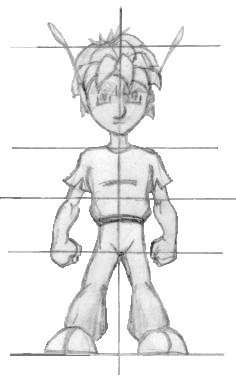
It means just what it says. You have to be able to draw well before you can animate well. When drawing living things it is important to know their anatomy not just so that you can draw them accurately but it also helps to understand how to understand how they move. Drawing something is easier if you first
break it down into its simplest shapes and then go into more detail from there(getting the proportions right becomes a lot easier).